Fire stopping pipes through walls
Copper, steel, plastic, lagged or bare. Each pipe through a fire wall needs its own kind of seal.
- Every seal labelled and photographed
- BM TRADA / FIRAS-certificated contractors
- Written price before any work
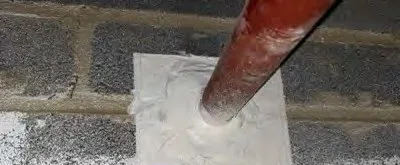
In the photo a single pipe comes through a block wall. Round it is a square of board, and round the pipe where it enters the board, a collar of white sealant. It is labelled and photographed. Small, simple, and the right answer for that pipe in that wall.
The pipe material decides most of what happens next.
Plastic pipes
PVC and polypropylene soften and fall away in a fire. The hole left behind is the full size of the pipe. So plastic pipes over a small size take an intumescent collar on each side of the wall, or a wrap set into the wall, which swells and closes the bore.
Copper and steel
Metal pipes do not melt, but they carry heat through the wall to the other side. Sealant tested with metal pipes fills the annular gap. For some sizes and ratings the pipe also needs a length of fire-rated lagging either side, so it cannot set fire to things touching it on the far side.
Lagged pipes
Heating and air conditioning pipes are often lagged with foam insulation. Foam lagging burns. Either it is cut back and replaced with a fire-rated lagging at the wall, or the seal uses a wrap tested on that lagging. This is the detail most often got wrong in plant rooms.
Old holes
When a pipe has been taken out, the hole stays. Empty holes are filled solid with mortar or a tested sealant, depending on size.
The work is carried out by our BM TRADA / FIRAS-certificated contractors. Each pipe seal gets a number, a label and a photo.
Send the postcode, the line from the assessment and a photo or two. We will tell you what it involves and roughly what it costs.