Fire stopping around cables
One cable through a wall is easy. Forty data cables in a bundle is not.
- Every seal labelled and photographed
- BM TRADA / FIRAS-certificated contractors
- Written price before any work
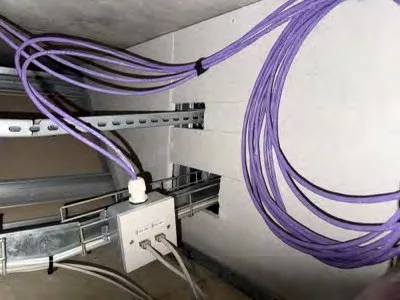
The photo on this page shows a loop of purple data cables going through a white board at the top of a wall, with a tray beside them. Each cable is a small hole. Bundled together they make one big one, with gaps between the cables that smoke goes straight through.
Single cables
A single power or alarm cable through a block wall needs a hole only a little bigger than the cable, filled with intumescent sealant to the depth the product asks for. If the hole is much bigger than the cable, it needs packing first.
Bundles
Bundles are harder. Sealant cannot reach into the middle of a tight bundle. The usual answers are to fan the cables out so each can be sealed, to run them through a tested sleeve, or to use a batt with each cable sealed where it passes. Some products are tested on tight bundles up to a stated diameter. The data sheet has the limit.
Trays and baskets
A tray through a wall is usually sealed with coated batt cut round it, plus sealant round each cable and along the joins. Some systems also need the cables coated for a short distance either side.
The next cable
Cable seals are the ones that get broken. Every new circuit, alarm cable or broadband line needs a way through. A sleeve with a resealable plug, or a batt with a spare cut and a label saying what to use, saves the next installer pushing a screwdriver through.
Our BM TRADA / FIRAS-certificated contractors carry out the work and record each seal.
Send the postcode, the line from the assessment and a photo or two. We will tell you what it involves and roughly what it costs.